
The Body as Asset: Jeffrey Epstein and the Ethics of Vitality Extraction
- Mar 23
- 8 min read
On the continuity between sexual predation and the emerging economy of biological longevity
By Dr. Marcus Robinson | DCH IHP QBH
I. The Pattern Before the Man
Jeffrey Epstein was not an aberration. This is the most important and most resisted insight in the ongoing effort to understand what he represented. He was, in every structural sense, an exemplary case — a man whose crimes were not the product of private pathology but of a system that had evolved, over centuries, to make such crimes not merely possible but reliably invisible.
That system has a logic. Across every civilization that has risen and fractured, one pattern recurs with the reliability of geology: the powerful extend their lives — their vitality, their pleasure, their biological and social reach — by shortening, diminishing, or consuming others. In ancient empires it wore the robes of divine right. In colonial centuries it wore the language of civilization and commerce. In the industrial age it wore the logic of the market. The Epstein network wore the costume of philanthropy, finance, and scientific patronage.
The costume changes. The transaction does not.
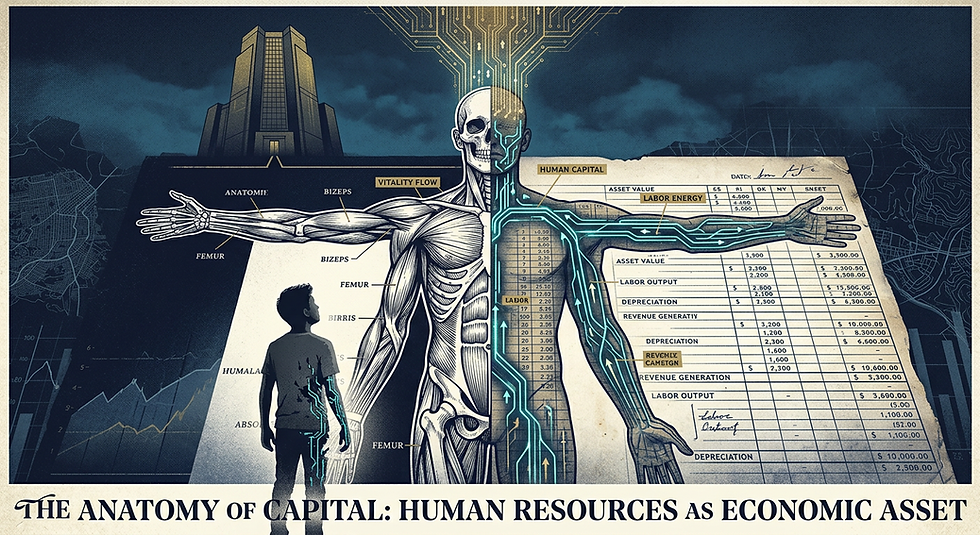
What Epstein extracted was not primarily money. It was something more fundamental: the vitality of young women and girls — their bodies, their futures, their possibilities — converted into assets that circulated among a network of powerful men. The language of finance is not incidental here. Epstein understood himself as operating a system of exchange. Bodies were the commodity. Access was the currency. Impunity was the infrastructure.
Epstein did not invent the transaction. He industrialized it, networked it, and — for over two decades — protected it with the full architecture of elite immunity.
II. The Architecture of Impunity
One of the most studied aspects of the Epstein case is the question of how it persisted for so long without consequence. The answer that most investigators have converged on — prosecutorial failures, institutional cover, the social networks of the wealthy — is accurate as far as it goes. But it misses the structural dimension.
Epstein's impunity was not accidental. It was engineered. The mechanisms that protected him — jurisdictional fragmentation across private islands, US states, and European capitals; the participation of institutional figures whose own reputations became collateral in his protection; the cultivation of scientific and academic legitimacy as a social shield — were not random features of his biography. They were, in retrospect, a nearly perfect instantiation of what we might call the architecture of impunity: the systematic design of legal, reputational, and geographic structures that place certain transactions beyond the reach of accountability.
This architecture is not unique to Epstein. It is the load-bearing infrastructure of every extraction regime in history. What made Epstein's version distinctive was its sophistication and its scientific ambition. He was not merely a predator with powerful friends. He was a man who believed — and who said, explicitly and publicly — that the future of humanity lay in the redesign of the human body. And who appeared to believe that young, vulnerable bodies were the appropriate substrate for that redesign.
His interest in eugenics and in what he called "seeding the human race" with his DNA is well documented. Less examined is the continuity between that ambition and his predatory behavior. Both expressed the same underlying premise: that certain bodies exist as raw material for the projects of more powerful ones.
III. From Predation to Product: The Longevity Economy
It would be convenient if Epstein's premise — that younger, more vital bodies are legitimate resources for those with sufficient power to extract from them — had died with his prosecution. It has not. It has, in several measurable ways, moved from the criminal fringe to the scientific mainstream, dressed in the white coat of longevity medicine and the venture capital prospectus of the life-extension industry.
Consider parabiosis — the practice of transfusing blood plasma from young donors into older recipients to confer cellular and metabolic benefits. The science is contested. The clinical evidence in humans remains thin. But the market is not waiting for the evidence. Startups have emerged offering plasma transfusions from young donors to wealthy older clients at prices that put the clientele firmly in the upper echelons of the wealth distribution. The transaction is almost perfectly legible as a market version of what Epstein did through coercion: the vitality of the young, sold to extend the biological comfort of the old.
The fact that the plasma donors in these commercial arrangements have nominally consented is ethically relevant, but not ethically sufficient. Consent, when structured by severe economic asymmetry, is not simply free. When the donor is twenty-two and economically precarious and the recipient is sixty-five and wealthy enough to pay thousands of dollars for a single infusion, the transaction carries a coercive gradient that the consent form does not neutralize. We have learned this lesson in other markets — in the history of organ procurement, of surrogacy, of labor in extractive industries — and the longevity economy is not exempt from it.
The question is not whether the young person signed the form. It is whether the social and economic conditions in which they signed it left them a meaningful alternative.
Anti-aging biologics more broadly — therapies derived from fetal tissue, from umbilical cord blood, from the cellular machinery of younger organisms — present a version of the same ethical structure. The sources of these therapies are, by definition, younger and more biologically vulnerable than the recipients. The extraction gradient runs in one direction. And the impunity gradient — the question of who bears risk, who is monitored, who can afford to sue if something goes wrong — runs in the same direction.
IV. Attention as Vitality
The extraction of biological material is not the only domain in which the Epstein structure replicates. The attention economy — the industrial-scale harvesting of human cognitive engagement by digital platforms designed to maximize time-on-device — is a form of vitality extraction that operates at civilizational scale.
This claim requires care. Epstein's crimes were violent and personal in ways that distinguishes them from the design choices of a social media platform. But the structural logic is recognizable: young people, whose neurological and psychological development makes them particularly susceptible to the reward mechanisms built into digital products, have their attention extracted and converted into assets — advertising revenue, behavioral data, political influence — that flow almost entirely to a small class of owners and investors whose own children are often, notably, in schools that prohibit the use of the very products being sold.
The asymmetry here is not incidental. The architects of the attention economy have, in many documented cases, made explicit decisions to withhold from their own children the products they deploy against other people's children. This is not hypocrisy in the ordinary sense. It is the operational signature of an extraction regime: those who design and benefit from the system arrange their own lives so as to be exempt from its costs.
What connects this to Epstein is not moral equivalence — it is structural family resemblance. Both operate by identifying a population whose vulnerability makes extraction efficient, building institutional and technological infrastructure that normalizes the extraction, and insulating the beneficiaries from accountability through wealth, legal architecture, and narrative control.
V. The Ethics of the White Coat
Science is not innocent in this. One of the more troubling features of the Epstein case — troubling precisely because it has received insufficient scrutiny — is the degree to which scientific legitimacy served as a form of social laundering for his network and his ambitions. Eminent researchers accepted his funding. Prestigious institutions took his money. The implicit exchange was not merely financial: it was reputational. His scientific patronage allowed him to inhabit a moral register — the disinterested pursuit of human knowledge and welfare — that his actual activities grotesquely contradicted.
This laundering dynamic is not unique to Epstein. It is a structural feature of the relationship between concentrated wealth and scientific institutions. When billionaires fund longevity research, they are not simply writing checks; they are purchasing the moral credibility of science as a cover for what is, at its base, a private desire to extract biological advantage from the social world. The research may produce genuine knowledge. But the frame within which it is funded, prioritized, and applied is set by the interests of those who can afford to fund it — and those interests are not the same as the interests of the populations whose vitality is being harvested in the process.
This demands a specific kind of ethical scrutiny — not a blanket rejection of longevity science, which would be both impractical and intellectually dishonest — but a rigorous interrogation of the extraction gradient embedded in any specific research program or clinical application. Who are the sources of the biological material being used? Under what conditions did they provide it? Who are the intended beneficiaries, and what is the economic structure of access to the resulting therapies? Who bears the risk of adverse outcomes? Who profits from the successful ones?
These are not exotic questions. They are the standard questions of research ethics, applied consistently. The fact that they are not being asked with sufficient consistency or rigor in the longevity economy is itself a symptom of the problem.
The white coat does not sanitize the transaction. It obscures it.
VI. What Epstein Should Have Taught Us
The Epstein case produced a great deal of commentary on individual culpability — who knew, who enabled, who looked away. It produced rather less commentary on the systemic conditions that made the network possible and persistent. This imbalance is characteristic of how extraction regimes survive: by channeling outrage into the episodic and personal, and away from the structural and durable.
What Epstein should have taught us is that the transaction he conducted — the extraction of vitality from the young and vulnerable for the benefit of the powerful — is not an aberration requiring a villain. It is a pattern requiring a system. And the system that enabled Epstein's specific crimes is the same system now underwriting, in rather more respectable forms, the longevity economy, the attention economy, and the broader architecture of biological and cognitive extraction that is becoming, in the twenty-first century, one of the central sites of inequality.
To understand Epstein only as a predator is to miss the lesson. To understand him as a case study in the institutional and structural conditions that enable extraction — and to ask, rigorously and without sentimentality, which of those conditions remain fully intact — is to begin to ask the right question.
The bodies that generate the plasma transfusions, the anti-aging biologics, the clicks and engagement metrics are not abstract. They belong to people whose vulnerability is not incidental to the transaction but structural to it. To engage seriously with the ethics of the longevity and attention economies is to acknowledge that the Epstein network was not ended by his prosecution. It was, in certain respects, sublimated — its logic diffused into markets and research programs and platform designs that have not yet attracted the same prosecutorial attention, and may never attract it, because they operate with the full legitimacy of science, capital, and consent.
The costume changes. The transaction does not.
The author acknowledges the source framework developed in his "The Vitality Extraction Regime" (unpublished manuscript), which provided the conceptual architecture for this analysis.
About the Author:
Marcus Robinson is the founder of the Adaptive Terrain Institute and a leading voice in the emerging field of multisystem human ecology. His work blends scientific rigor, ancestral intelligence, and systems‑level analysis to map how individuals and civilizations adapt under stress. A longtime strategist, educator, and movement architect, Marcus helps leaders navigate complexity by revealing the hidden terrains—biological, psychological, relational, and civilizational—that shape human behavior and collective futures. His writing invites readers into a deeper coherence, where personal transformation and societal evolution become part of the same living system.


Comments